Wolverine blend Calculator
Enter your Wolverine blend vial size, the water you add and your dose to get the units to draw on a U-100 syringe. The units chart and water table below cover 10, 20 mg vials.
How many units is each Wolverine blend dose?
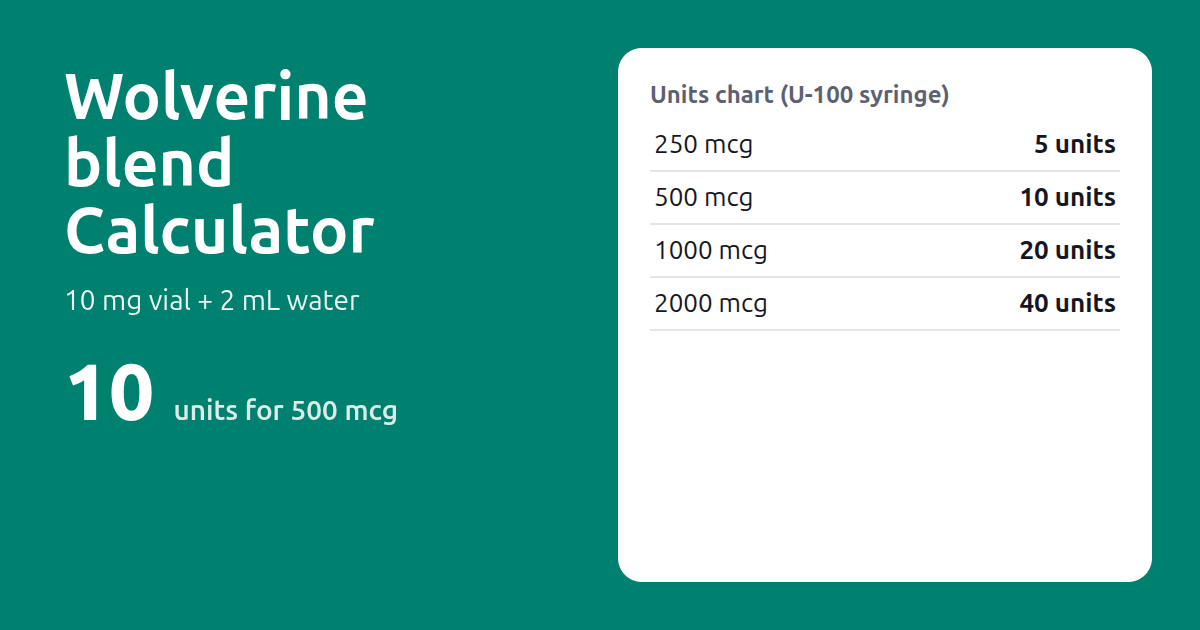
Units on a U-100 insulin syringe for common amounts, with 2 mL of bacteriostatic water in the vial. With a different water amount, use the calculator above.
| Dose (mcg) | 10 mg vial + 2 mL | 20 mg vial + 2 mL |
|---|---|---|
| 250 mcg | 5 units 0.05 mL | 2.5 units 0.025 mL |
| 500 mcg | 10 units 0.1 mL | 5 units 0.05 mL |
| 1000 mcg | 20 units 0.2 mL | 10 units 0.1 mL |
| 2000 mcg | 40 units 0.4 mL | 20 units 0.2 mL |
Doses on this page are for the total blend. Divide by the ratio on the vial label to get each peptide's share.
How much bac water for Wolverine blend?
Water only changes how much liquid each dose takes up, not how much Wolverine blend is in it. To land a 500 mcg dose on a round number of units, add:
| Vial | So 500 mcg = 10 units | So 500 mcg = 20 units |
|---|---|---|
| 10 mg | 2 mL | 4 mL |
| 20 mg | 4 mL | 8 mL |
How do you reconstitute Wolverine blend?
- Concentration: 10 mg ÷ 2 mL = 5 mg/mL (50 mcg per unit).
- Volume to draw: 500 mcg ÷ 5 mg/mL = 0.1 mL.
- Syringe units: 0.1 mL × 100 = 10 units on a U-100 syringe.
Example numbers only. They come from the default vial, water and amount above, not a recommendation.
What else do people ask about Wolverine blend?
How many units is 500 mcg of Wolverine blend?
It depends on how much water is in the vial. With a 10 mg vial and 2 mL of water, 500 mcg is 10 units (0.1 mL) on a U-100 syringe. Change the vial or water amount above to see your number.
How much bacteriostatic water do I add to a Wolverine blend vial?
There's no single right amount. More water makes each unit weaker and the draw bigger, which is easier to measure. Less water makes the draw smaller. Many people pick an amount that puts their dose on a round number of units. The "Units → water to add" tab and the table above work this out.
How many doses are in a 10 mg Wolverine blend vial?
At 500 mcg per dose, a 10 mg vial holds 20 doses. The amount of water doesn't change this.
Does this page recommend a Wolverine blend dose?
No. This page only converts amounts you enter into syringe units. Ask a licensed clinician about whether and how to use Wolverine blend.